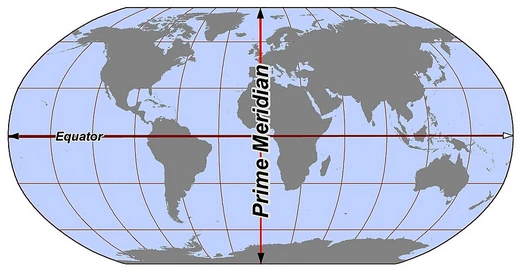
Northern Hemisphere
The Northern Hemisphere contains most of the world's continents and major landmasses.

The Northern Hemisphere is the half of Earth that is north of the Equator. In geography and cartography, hemispheres are any division of the globe into two equal halves. The Northern Hemisphere is one of the primary latitudinal divisions, separated from the Southern Hemisphere by the Equator.
- surface_water_percentage
- 60.7%
- land_percentage
- 67.3% of Earth's land
- population_2015
- approximately 6.4 billion (87.0% of Earth's total)
- key_climate_zones
- Arctic, Northern temperate, Tropical
- major_ocean_currents
- clockwise-turning gyres in North Atlantic and North Pacific
Lore & Background
The Northern Hemisphere is defined by the Equator as its southern boundary. It includes most of the world's land area, as the Land Hemisphere is centered near 47°N, 1°E, near the city of Nantes, France, and contains the largest possible area of land, including most of the world's continents and major landmasses. The Water Hemisphere, centered near 47°S, 179°W in the South Pacific Ocean, contains the largest possible area of water, including most of the Indian, Pacific, and Southern Oceans. The Northern Hemisphere's geography is shaped by these divisions, with the Equator serving as the primary latitudinal marker for north-south division.
Reader's Guide
When studying Earth's geographic distribution, cultural differences, and other geographic, demographic and socioeconomic features, the Northern Hemisphere is a key division. It is one of the two halves created by the Equator, which splits the globe into northern and southern halves. The Prime meridian divides the globe into western and eastern halves. Alternative hemisphere schemes can divide the planet along cultural or religious lines, or to maximize the prominence of geographic features, such as the land-water division. The Land Hemisphere, centered near 47°N, 1°E, contains the largest possible area of land, including most of the world's continents and major landmasses. The Water Hemisphere, centered near 47°S, 179°W, contains the largest possible area of water, including most of the Indian, Pacific, and Southern Oceans.
Did You Know?
- The Northern Hemisphere is the half of Earth north of the Equator.
- The Land Hemisphere, which contains the largest possible area of land, is centered near 47°N, 1°E, near Nantes, France.
- The Water Hemisphere, containing the largest possible area of water, is centered near 47°S, 179°W, southwest of the Chatham Islands, New Zealand.
- The Equator divides the globe into northern and southern halves.
- The Prime meridian divides the globe into western and eastern halves.
Frequently Asked Questions
What exactly is the Northern Hemisphere?
It is the portion of Earth that sits above the equator line. In the wider Solar System, 'north' is defined by whichever side of the invariable plane Earth's North Pole occupies, and the Northern Hemisphere is the half on that same side.
How many people live in the Northern Hemisphere?
As of 2015, roughly 6.4 billion people—about 87% of the global population—reside north of the equator. That density is tied to the fact that the Northern Hemisphere also holds around two-thirds of all Earth's land area.
Why do day lengths and temperatures shift through the year here?
Earth's axis is tilted at approximately 23.44 degrees, so the amount of direct sunlight the Northern Hemisphere receives changes as the planet orbits the Sun. This tilt produces the familiar long-summer / short-winter day pattern, and temperature extremes lag a few weeks behind the solstices.
What major climate zones does the Northern Hemisphere span?
Stretching from the Arctic through the Northern temperate belt down into the Tropical zone near the equator, the Northern Hemisphere covers three primary climate regions. That breadth of zones is a key reason it supports far more varied ecosystems than the ocean-heavy Southern Hemisphere.
How do the big ocean gyres behave in the Northern Hemisphere?
The North Atlantic and North Pacific each host large, clockwise-rotating surface-current systems. These gyres arise because the Coriolis effect deflects moving water to the right on the northern side of the planet, locking the circulation into a consistent clockwise spin.
More in Lines & Hemispheres 1-24
Related in Lines & Hemispheres
Links follow this subject's own source article.
Elsewhere in the Lines & Hemispheres universe
Spotted an error? Know more?
This is a living reference — every entry is fact-audited, and reader corrections feed straight into our audit queue. Suggest an edit · See this site's audit record