Lines & Hemispheres 1-24
24 entries in the Lines & Hemispheres compendium.
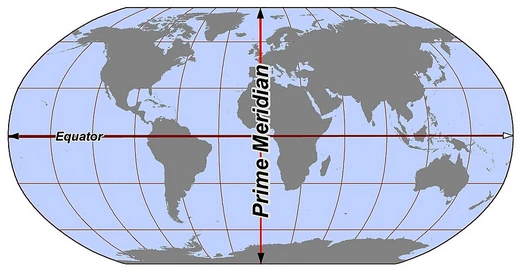
180th meridianThe 180th meridian divides hemispheres and anchors the International Date Line.International Date LineBoundary between calendar days, roughly along 180° longitude.EquatorImaginary line dividing Earth into Northern and Southern Hemispheres.Tropic of CancerNorthernmost latitude where the Sun appears directly overhead.Tropic of CapricornSouthernmost latitude where the Sun is directly overhead.Antarctic CircleSouthernmost major latitude circle marking the Antarctic region.Circle of latitudeParallel circles defining latitude on Earth.Meridian (geography)A line of longitude connecting points of equal longitude.North PoleNorthernmost point on Earth, located in the Arctic Ocean.South PoleSouthernmost point on Earth, marked by shifting ice and historic expeditions.Celestial poleFixed points in the sky around which all stars appear to rotate.Great circleThe largest circle on a sphere, analogous to a straight line.AzimuthHorizontal angle from north used in navigation and astronomy.Cardinal directionFour main compass points used for navigation and orientation.NorthOne of the four cardinal directions, opposite south.SouthOne of the four cardinal directions, opposite north.EastCardinal direction of sunrise, opposite west, abbreviated as E.WestCardinal direction opposite east, where the Sun sets.Eastern HemisphereHalf of Earth east of the prime meridian, encompassing Afro-Eurasia and Australia.Western HemisphereU.S. Department of Defense school for Latin American security personnel, formerly the SchoNorthern HemisphereThe Northern Hemisphere contains most of the world's continents and major landmasses.Southern HemisphereThe Southern Hemisphere is Earth's southern half, mostly ocean.Land and water hemispheresEarth's hemispheres maximizing land and ocean coverage, respectively.Hemispheres of EarthEqual halves of Earth divided by latitude, longitude, or cultural lines.
Browse Lines & Hemispheres 1-24 in the interactive codex →